
Why Most People Quit Posting on LinkedIn After 2 Weeks (And How to Never Stop)
I’ll be honest with you — for years, I treated LinkedIn the same way most freelancers do. I’d get motivated on a Monday, post something, feel good about it, and then… nothing. Two weeks would go by. Sometimes a month. Then I’d log back in, see my last post sitting there awkwardly, and feel that little pang of guilt before closing the tab again.
Eventually I stopped trying to fix this with willpower and started looking into LinkedIn post automation instead — and it turned out to be a much smaller problem to solve than I expected.
If that sounds familiar, you’re not lazy. You’re just human. Writing something worth posting, every single day, on top of actually running your business, is genuinely hard to sustain. I’ve built websites for clients for over a decade, and I can tell you — the businesses that struggle most with content aren’t the ones with nothing to say. They’re the ones with no system for saying it consistently.
That’s the part nobody talks about. Everyone tells you “post consistently on LinkedIn” like it’s a switch you can just flip. Nobody tells you how to actually keep doing it when you’re busy, tired, or just don’t feel like writing that day.
The Real Cost of Going Quiet
Here’s what happens when your posting goes silent for a few weeks: it’s not just that one post you missed. It’s the compounding effect. LinkedIn’s algorithm rewards accounts that show up regularly — the same way a shop that’s open every day builds more foot traffic than one that opens whenever it feels like it. Every gap resets some of that momentum.
And for freelancers and small business owners specifically, LinkedIn is often the cheapest lead source you have. No ad spend, no cold outreach fatigue — just consistent, useful posts that keep you in front of the right people until they’re ready to reach out.
The problem was never that LinkedIn doesn’t work. It’s that staying consistent on it, by hand, doesn’t scale with everything else you’re juggling.
What Is LinkedIn Post Automation?
At its simplest, LinkedIn post automation just means using a tool to write, design, and publish your posts on a schedule — without you sitting down to do it manually each time. Instead of opening LinkedIn every morning wondering what to say, you set up a system once, and it keeps showing up for you.
That can mean a few different things depending on how far you take it: some tools just schedule posts you’ve already written. Others — like the one I ended up building — go a step further and actually generate the post and the image for you too, based on a topic you give it. Either way, the goal is the same: staying visible on LinkedIn stops depending on whether you remembered to post today.
If you’d rather skip ahead and see whether this fits your business, you can reach out here anytime — no need to wait until the end of the post.
What Changed for Me
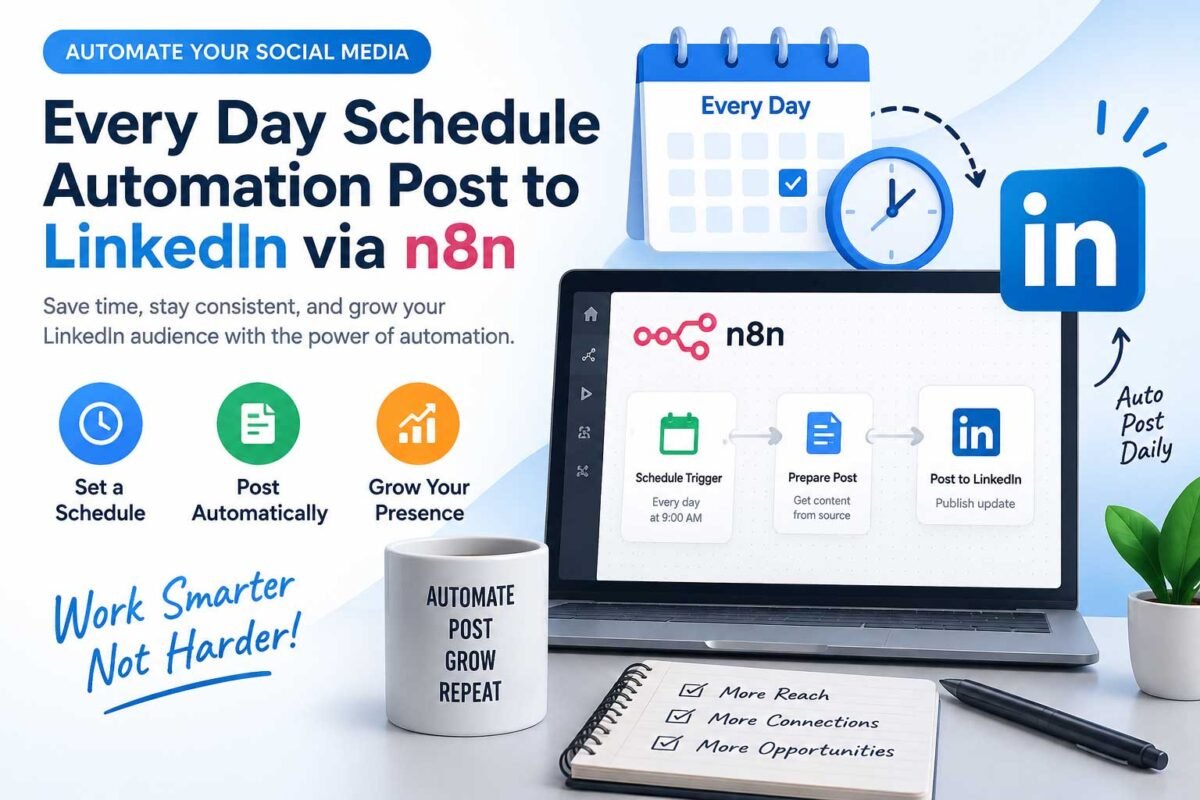
Earlier this year, I started learning n8n — a tool for building automated workflows — mostly out of curiosity about AI agents. Somewhere in that process, I realized I could solve my own LinkedIn problem with it.
Here’s roughly what I built:
I keep a simple list of post ideas in a spreadsheet — just topics, nothing fancy. Every morning, an automation quietly picks the next one, writes a short, natural-sounding post about it, generates a matching image, and publishes it straight to my LinkedIn profile. Then it marks that topic as done, so tomorrow it moves to the next one automatically.
I don’t open LinkedIn to make this happen. I don’t sit down and write. The only thing I ever have to do is occasionally add new topics to the list — which takes about five minutes, whenever I feel like it.
The part that surprised me most wasn’t that it worked technically — it’s that the posts didn’t read like something a machine spit out. That was the one thing I refused to compromise on when building it. A LinkedIn post that sounds like a press release helps nobody. So the system is specifically tuned to write the way an actual person shares a thought — a little personal, a little imperfect, not stuffed with buzzwords and hashtags.
This Isn’t Just a “Nice Trick” — It’s a Business Tool
Once I had this running for myself, it became obvious this wasn’t just a personal productivity hack. It’s exactly the kind of system a lot of small businesses and solo consultants need but never get around to building themselves — because between actually doing the client work and running the business, who has time to also learn workflow automation?
That’s genuinely the gap I ended up in a good position to fill. I already understand websites, and now I understand how to wire these AI + automation pieces together. So instead of just using this for myself, I started offering it as a service — building the same kind of system for other people’s businesses, connected to their own LinkedIn account, running on their own schedule.
Is This Actually Right for You?
Probably, if any of this sounds like you:
- You know LinkedIn could bring you leads, but you’ve basically given up trying to post consistently
- You’ve tried “batching content” before and it fell apart after a week or two
- You’d rather review and approve a post than write one from scratch
- You want to look active and professional online without content being a daily chore
It’s probably not the right fit if you want every post to be a deeply personal essay you write yourself — this works best for the steady, useful, “keeping you visible” kind of content, not your once-a-year big announcement post.
Want to See It Running for Your Business?
I’m not going to pretend this is some huge mysterious system — it’s genuinely a handful of connected steps, and I can set the whole thing up for you, pointed at your own LinkedIn account, without you needing to touch a single technical setting.
If reading this made you think “I really should be doing this,” that’s exactly the sign to reach out. Contact me here and tell me a bit about your business — I’ll walk you through what a setup like this would look like for you specifically, no pressure, no generic sales pitch.