
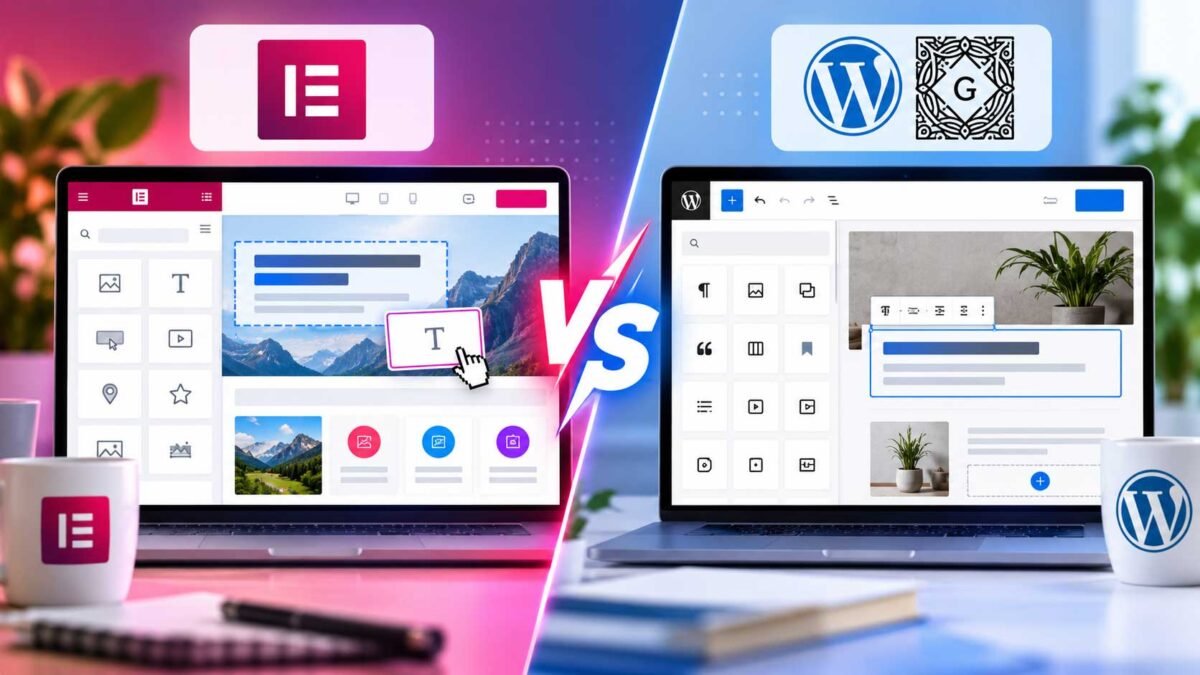
Elementor vs Gutenberg: Which Page Builder Should You Use?
I’ll save you the suspense buried at the bottom of most “Elementor vs Gutenberg” articles: I build almost every client site in Elementor, and I’ve been doing it for years. But I’m not writing this to sell you on my toolkit — I’m writing it because after building probably 150+ sites at this point, I’ve got real opinions about when Elementor genuinely earns its spot, and when I’d tell a client to save their money and stick with Gutenberg instead. That second part is the bit most comparison articles conveniently skip.
So let’s actually get into it — not the theoretical version, the “I’ve shipped both, here’s what actually happens” version.
First, What Are We Even Comparing?
Gutenberg is WordPress’s built-in block editor — free, baked into core, no plugin required. You build pages by stacking blocks: a paragraph block, an image block, a columns block, and so on. It’s gotten genuinely good over the past few years, especially with full site editing.
Elementor is a page builder plugin that replaces that experience with a drag-and-drop, visual, what-you-see-is-what-you-get editor. You’re not stacking abstract blocks — you’re literally dragging elements around a live preview of your page, adjusting spacing with sliders, and seeing every change happen in real time.
They’re solving the same basic problem — “help me build a page without writing code” — but they take genuinely different roads to get there.
Where Elementor Actually Wins (From Someone Who Uses It Daily)
The visual control is just better, full stop. When a client says “can you move that a little to the left and make it slightly bigger,” I can do that in about four seconds in Elementor, live, while they watch on a screen share. That kind of real-time, pixel-level control is still Elementor’s biggest advantage, and it’s why client-facing agencies like mine lean on it so heavily.
The template ecosystem saves real hours. Elementor’s library of pre-built templates and its Theme Builder (for headers, footers, archive pages, single post layouts) means I’m rarely starting from a blank page. For a client on a deadline, that’s not a luxury — it’s the difference between a two-day build and a two-week build.
Widgets that just work. Need a pricing table, a countdown timer, a testimonial slider, an animated icon box? Elementor has a widget for it, styled and functional in a couple of clicks. Recreating that in Gutenberg usually means stacking multiple plugins or writing custom CSS yourself.
Clients can actually use it after I leave. This matters more than people think. I hand off a lot of sites to non-technical business owners, and Elementor’s interface is intuitive enough that they can go in and swap out text or images themselves without calling me every time. That’s genuinely valuable for the client relationship long-term.
Where Gutenberg Actually Wins (Yes, It Does)
Here’s the part a lot of Elementor-loyal developers won’t tell you honestly, so let me be straight with you.
Speed and performance. Gutenberg is lighter. It’s part of WordPress core, so there’s no extra plugin loading additional CSS and JavaScript on every page. If a client’s single priority is a lean, fast-loading site — and their design needs are genuinely simple — Gutenberg will usually outperform an Elementor build out of the box, without needing extra optimization work.
No plugin dependency risk. Elementor is a third-party plugin. If it’s ever discontinued, has a major bug, or you decide to migrate away from it someday, unwinding a heavily built-out Elementor site can be a real project. A Gutenberg-built site is just… WordPress. It’s not going anywhere, because it is the platform.
It’s free, forever. Elementor’s core is free too, but the widgets, templates, and features most client projects actually need live behind Elementor Pro’s subscription. Gutenberg costs nothing, ever, for anyone, at any scale.
It’s genuinely improved — a lot. If you tried Gutenberg back in 2019 and hated it, you’re judging a version of the tool that doesn’t exist anymore. Full site editing, pattern libraries, and much better block-level design controls have closed a real chunk of the gap that used to exist between the two.
The Honest Comparison Table
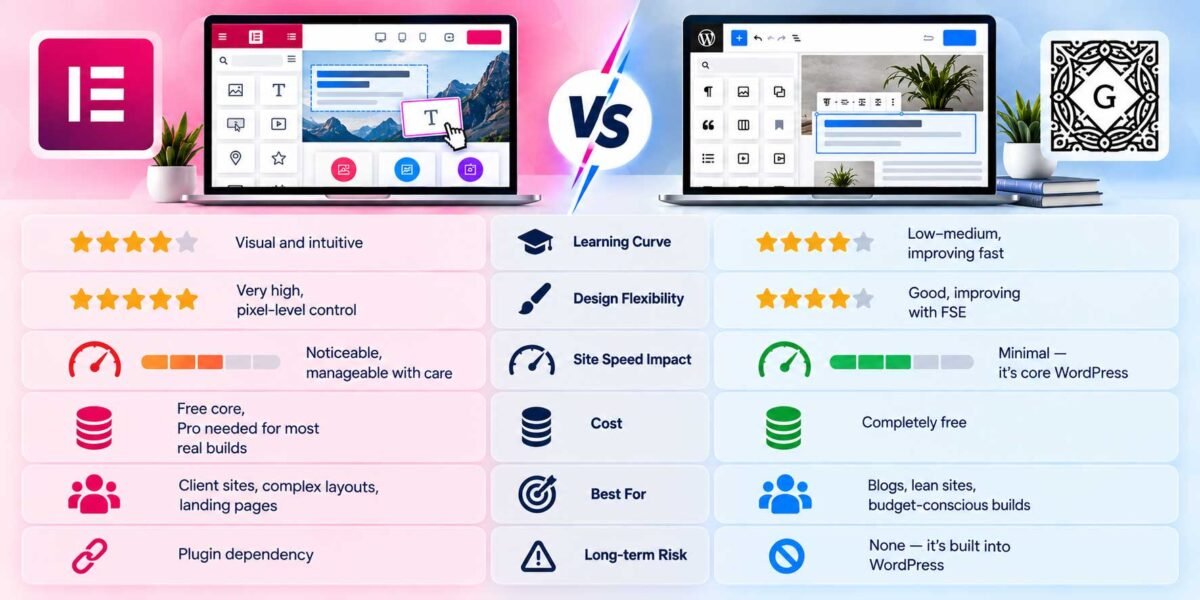
| Elementor | Gutenberg | |
|---|---|---|
| Learning curve | Low — visual and intuitive | Low–medium, improving fast |
| Design flexibility | Very high, pixel-level control | Good, improving with FSE |
| Site speed impact | Noticeable, manageable with care | Minimal — it’s core WordPress |
| Cost | Free core, Pro needed for most real builds | Completely free |
| Best for | Client sites, complex layouts, landing pages | Blogs, lean sites, budget-conscious builds |
| Long-term risk | Plugin dependency | None — it’s built into WordPress |
So, Which One Should You Actually Pick?
Here’s my honest, non-generic answer, based on what I actually recommend to real clients:
Pick Elementor if you’re building a business site, a landing page that needs to convert, or anything with custom layouts, animations, or a design that needs to match a brand precisely — and you (or someone) will be maintaining it long-term. This covers the majority of client work I do.
Pick Gutenberg if you’re running a blog, a simple informational site, or you genuinely care about squeezing out every last bit of page speed and want zero dependency on a third-party plugin’s roadmap. If your content is words and images more than complex visual layouts, Gutenberg does that job cleanly and for free.
And here’s the thing nobody says out loud enough: you don’t have to pick one forever. I’ve built plenty of sites where the blog runs on plain Gutenberg for speed, while the homepage and landing pages run on Elementor for design flexibility. WordPress lets you mix both on the same install, and honestly, that hybrid approach is quietly become one of my favorite setups for clients who want the best of both without compromising on either.
My Actual Take, One More Time
I use Elementor because the kind of work I do — custom client sites that need to look exactly right and be editable by non-technical owners — plays directly to its strengths. But if someone asked me to build a fast, simple, no-frills blog today, I wouldn’t reach for Elementor out of habit. I’d use Gutenberg, because it’s the right tool for that specific job. That’s really the whole answer: match the tool to what you’re actually building, not to whichever one has the louder marketing.
Not sure which one fits your project, or want a site built properly in whichever tool actually makes sense for you? Get in touch and I’ll help you figure it out — no pushing you toward whatever I personally prefer to use.