
Workflow Automation Agency: What They Actually Do, and How to Choose One
If you’re searching this, you’ve probably already decided automation is worth doing — you’re past the “should I bother with this” question and onto “who do I actually trust to build it.” That’s a harder question than it sounds, because this space is genuinely full of agencies promising the same vague things (“save time with AI-powered automation!”) without telling you what they actually build, how they price it, or what happens six months after launch when something breaks.
I’ve been on both sides of this — building automation systems for clients, and watching other agencies’ half-finished workflows get handed to me to fix after the original builder disappeared. So let me give you the honest version: what a workflow automation agency actually does, what separates a good one from a risky one, and the questions worth asking before you sign anything.
What Does a Workflow Automation Agency Actually Do?
At its core, a workflow automation agency connects the tools your business already uses — your website, CRM, email platform, spreadsheets, payment processor, support inbox — so that data and tasks move between them automatically instead of requiring a human to manually copy, check, or trigger each step.
In practice, that usually means:
- Mapping your current manual processes to figure out what’s actually worth automating (not everything is, and a good agency will tell you that)
- Building the workflows using tools like n8n, Zapier, or Make, often alongside custom code where off-the-shelf nodes don’t do exactly what’s needed
- Connecting your existing software via APIs so everything talks to each other reliably
- Testing thoroughly before anything goes live, because a broken automation can silently cause bigger problems than the manual process it replaced
- Documenting and handing off so you’re not permanently dependent on them just to understand what was built
- Ongoing support, since workflows need adjusting as your business and the tools you use both evolve over time
What Separates a Good Agency From a Risky One
This is the part most “how to choose” articles gloss over with generic advice like “check their reviews.” Here’s what I’d actually look for, having seen plenty of automation projects go sideways from the fixing-it side of the table.
They Ask About Your Process Before Pitching a Solution
If an agency jumps straight to “we’ll build you an AI agent that does everything” without first asking detailed questions about how your business actually operates today, that’s a red flag. Good automation starts with genuinely understanding your workflow, not fitting your business into whatever template the agency likes to sell.
They’re Honest About What Shouldn’t Be Automated
Not every manual task deserves automation — some genuinely need human judgment, and automating them badly creates more problems than it solves. An agency that never says “actually, you should keep doing that one manually” is probably optimizing for billable hours, not your actual outcome.
They Build on Tools You Can Actually See and Own
Be cautious of agencies that build everything inside a closed, proprietary system you can’t access or export from. Tools like n8n (especially self-hosted) and other transparent platforms mean you genuinely own what was built — you’re not locked into paying that one agency forever just to make a small change.
They Explain Pricing Clearly
Workflow automation pricing varies widely — some agencies charge a flat project fee, others bill hourly, others run a retainer for ongoing maintenance. None of these models is inherently wrong, but you should get a clear answer, not a vague “it depends” that never resolves into an actual number before you commit.
They Test Before Handing It Over
Ask directly: “How do you test this before it goes live, and what happens if something breaks after launch?” A serious agency has a real answer here — staging environments, test runs with real data, a support window after launch. A vague answer is a warning sign.
References From Businesses Like Yours
An agency that’s automated enterprise supply chains might not be the right fit for a 5-person WooCommerce store, and vice versa. Ask for examples of work specifically similar in scale and complexity to what you need.
What Should You Expect to Pay?
Costs vary enormously depending on scope — a single simple workflow (say, lead notification to Slack) might be a small, fast, affordable project, while connecting an entire tech stack across sales, support, and fulfillment is a bigger undertaking with a correspondingly bigger price tag. Be skeptical of anyone quoting a number before they’ve actually understood what you need built — that’s a sign of a templated sales process, not a tailored quote.
A reasonable approach, and the one I use with clients: start with one well-defined workflow, see the real-world results, and scale up from there based on actual ROI rather than a big upfront commitment to an ambitious roadmap that may or may not pan out.
Do You Need an “Agency,” or a Specialist?
Here’s something worth sitting with: the word “agency” conjures images of a big team, and for some projects — large-scale, multi-department automation across an enterprise — that scale genuinely helps. But for most small and mid-sized businesses, what actually gets the job done well is a focused specialist who deeply understands the specific tools involved (WordPress, WooCommerce, n8n, your CRM) and can move quickly without layers of account managers between you and the person actually building your workflows.
That’s honestly the model I run on with Varahi — I’m not pretending to be a 50-person shop, and for the size of project most small businesses actually need, that’s often an advantage, not a limitation. You’re talking directly to the person who builds it, start to finish.
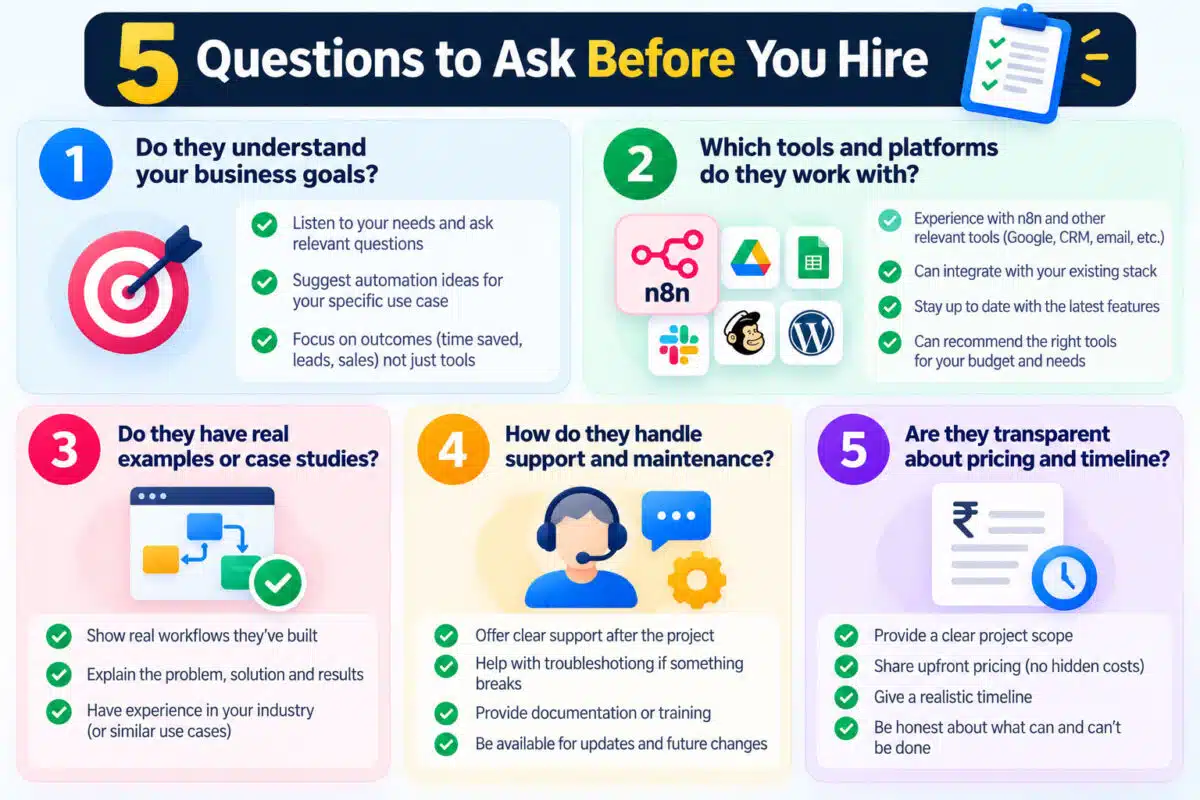
Questions Worth Asking Before You Hire Anyone
- What tools will you build this on, and will I have access to it myself afterward?
- Can you show me an example of a workflow similar to what I need?
- What’s your process for testing before something goes live?
- What happens if something breaks after launch — is that included, or billed separately?
- How do you price this, and when do I get a concrete number?
If those five questions get clear, confident answers, you’re probably in good hands. If they get vague, deflecting answers, keep looking.
Final Thoughts
A good workflow automation partner — whether that’s a large agency or a focused specialist — should feel like they’re genuinely trying to solve your specific problem, not sell you a package. Ask the questions above, start with one workflow instead of a massive overhaul, and judge the relationship by how it performs on that first project before committing to anything bigger.
Looking for someone to actually build this out for your business, without the agency overhead? Get in touch and let’s talk through what’s actually worth automating for you first.