
AI Automation Agency Services: What’s Actually Included (and What to Expect)
Search for “AI automation agency services” and you’ll get a wall of pages promising to “transform your business with cutting-edge AI.” Lovely. But what do they actually do all day? What lands in your inbox on delivery day? And which of these services is worth paying for at your stage?
I build these systems for a living, so let me skip the buzzwords and lay out the services menu as it really looks. If you want help choosing an agency, I’ve covered that separately in my workflow automation agency guide. This post is about what you’re buying.
What Is an AI Automation Agency?
An AI automation agency designs, builds, and maintains systems that use automation tools and AI models to handle work your team currently does by hand. That might mean answering customer questions, qualifying leads, moving data between apps, drafting replies, or generating reports.
The “AI” part matters because it lets automation handle messy inputs. Classic automation follows fixed rules: if a form is submitted, send an email. AI-powered automation can read a free-text enquiry, work out what the person wants, and decide what to do next. That is the real difference, and it’s what the better agencies sell.
The Core AI Automation Agency Services
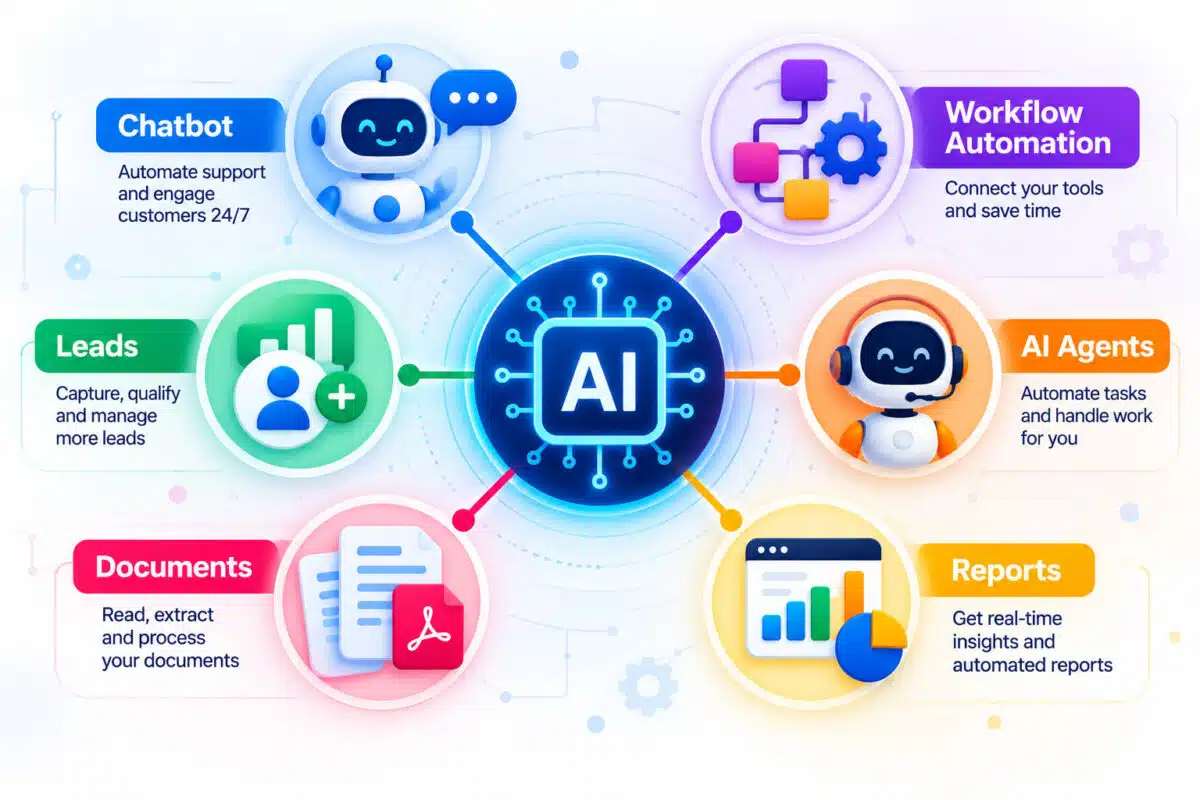
Here are the services you’ll see on almost every agency’s menu, with an honest read on each.
1. AI Chatbots and Virtual Assistants
A chatbot on your website or messaging channels answers common questions, collects contact details, and hands off to a human when it gets out of its depth. Modern ones can be trained on your own content (your FAQs, product pages, policies), so they answer in your terms rather than generic ones.
Worth it when: you get the same questions repeatedly, or enquiries arrive outside business hours. Be careful about: bots with no human handoff. Nothing annoys a customer more than a bot that can’t admit defeat.
2. Workflow Automation
This is the backbone of most engagements: connecting your tools so work moves between them automatically. A form submission lands in your CRM, your team gets pinged, an invoice goes out when a project closes, and a weekly report builds itself. Tools like n8n, Zapier and Make do the heavy lifting, often with custom code filling the gaps.
Worth it when: someone on your team copies data from one place to another more than a few times a week.
3. Lead Generation and Lead Qualification
AI can score and sort incoming leads, enrich them with public company information, draft a personalised first reply, and route hot leads to the right person immediately. The important word there is incoming. Systems that respond fast and qualify well will beat spray-and-pray outreach, and they keep your reputation intact.
Worth it when: leads arrive faster than you can follow up on them, or good ones go cold because nobody replied in time.
4. AI Agents for Multi-Step Tasks
This is the newer, more ambitious end of the menu. Instead of a fixed workflow, an AI agent is given a goal (say, “research this prospect and prepare a briefing”) and decides which steps to take. It’s powerful, but it needs guardrails, testing, and a person checking the output while trust is being built.
Worth it when: the task needs judgment across several steps, and a small error is cheap to catch.
5. Document and Email Processing
Reading invoices, sorting a shared inbox, pulling details out of PDFs, summarising long threads. It’s unglamorous, and it often gives the fastest payback of anything on this list.
6. Reporting and Monitoring
Automated dashboards and alerts that tell you when something changes, such as a sales dip, a failed payment, a stock level, or a website error, so you hear about it before a customer does.
What an Engagement Actually Looks Like
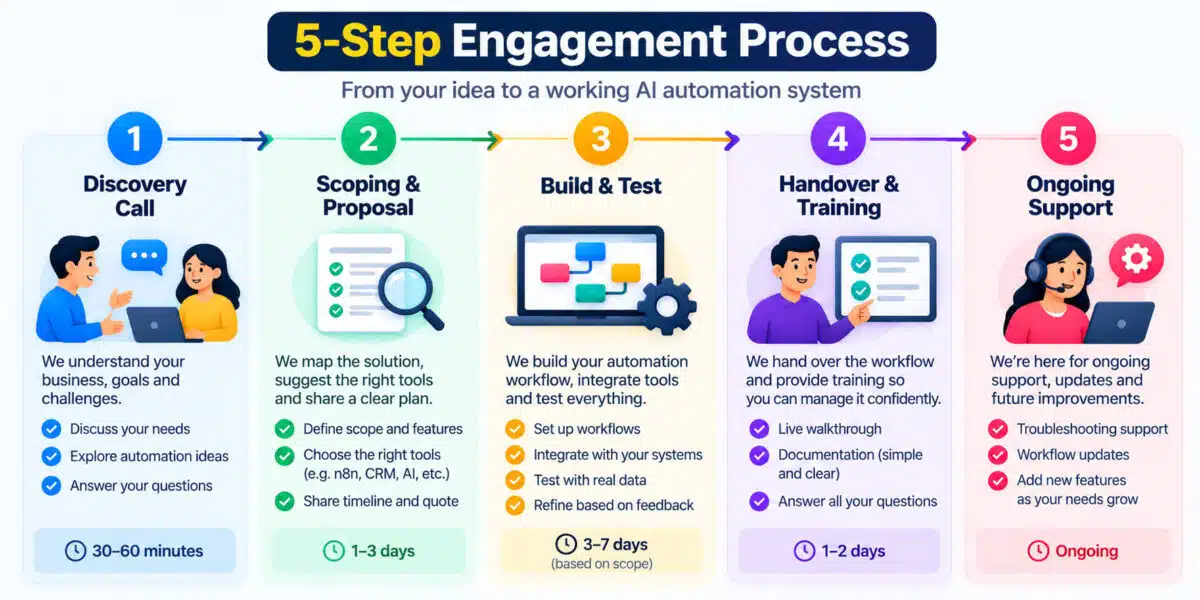
Whatever the agency calls its process, a healthy engagement tends to run like this:
- Discovery. They map your current process and find the repetitive, rule-driven steps. A good agency will tell you what not to automate.
- Scoping. You agree what gets built, what it connects to, and what “done” means, ideally with a fixed price or a clear estimate.
- Build and test. The workflows get built and tested with real data before going live.
- Handover. You get documentation and access to what was built, so you aren’t locked in.
- Support. Workflows need tweaking as your tools and business change. Ask up front whether support is included or billed separately.
How Much Do AI Automation Services Cost?
It varies widely, and anyone quoting a figure before understanding your needs is guessing. A single, well-defined workflow is a small project. Connecting several systems with AI decision-making in the middle is a larger one. Pricing models range from fixed project fees to hourly work to monthly retainers.
My advice is the same as always: start with one workflow, measure what it saves, then decide what to build next. It’s the cheapest way to learn whether an agency, or a freelancer, is the right fit.
Agency or Specialist?
“Agency” suggests a big team, and for large multi-department projects that scale genuinely helps. For most small and mid-sized businesses, a focused specialist who knows the tools well and works directly with you is quicker and often cheaper, because there are no account managers between you and the person building. That’s how I work: you deal with the person doing the build, start to finish.
Questions to Ask Before You Commit
- Which of these services do you actually deliver, and can you show me a similar project?
- Which tools will you build on, and will I own the result?
- How do you test before launch, and who fixes things if they break afterwards?
- What does ongoing support cost?
- What would you not automate in my business?
Clear answers to those five questions tell you more than any “top agencies” list will.
Final Thoughts
AI automation services aren’t magic, and they aren’t one product. They’re a set of practical tools that remove repetitive work: chatbots for the first line of enquiries, workflows for the plumbing between your apps, and lead systems that make sure nobody waits. Pick the one that matches your biggest daily irritation, start small, and expand once it’s paying for itself.
Want to know which of these services would pay off first in your business? Get in touch and I’ll help you pick the right starting point, then build it.